God and the Son
Paradise LostGod and the Son form the poem’s central divine relation: the Father is the originating will and supreme sovereign, while the Son is his uniquely begotten Word, wisdom, power, visible expression, appointed head, and willing agent. Their unity does not erase distinction. God decrees, commissions, and judges; the Son answers, acts, mediates, suffers, triumphs, and finally returns all authority to the Father. Through this reciprocal relation, divine monarchy is represented not as arbitrary domination but as an order whose legitimacy is affirmed by love, obedience, merit, and the Son’s self-offering for the created world.
Divine Identity and Shared Glory
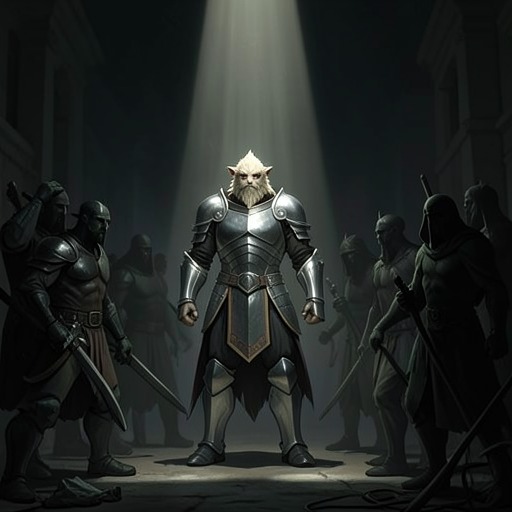
God declares the Son begotten and anointed before the assembled Angels, appointing him Head and requiring every heavenly knee to bow before him. The decree makes obedience to the Son obedience to God himself: resistance to the appointed Vicegerent breaks the unity of Heaven and leads to exclusion from blessed vision. The Son’s position is therefore not merely administrative. He is the one through whom the Father’s authority is expressed, and his reign gathers the celestial orders into a single spiritual unity.
The poem repeatedly describes this identity through images of perfect correspondence. The Son is the Father’s Word, wisdom, and effectual might; in the Son’s face, the invisible God becomes visibly manifest. The Son is also called the Father’s “sole complacence,” and God says that in him his glory is beheld in full resplendence. Such language makes the relation both filial and ontological: the Son belongs uniquely to the Father while expressing what the Father is. The Son’s authority is consequently neither an external grant masking inferiority nor an independent rival sovereignty. It is received from the Father and remains an exact revelation of the Father’s own will.
This structure explains why the rebellion of Satan is directed so intensely against the Son. Satan treats the Son’s anointing as an imposed elevation that diminishes the older celestial powers, arguing that beings equal in freedom cannot rightly submit to a monarch. The poem answers this challenge through the Son’s origin and function: all heavenly spirits were created through him, and their orders and degrees are not obscured by his reign but made more illustrious by their union under one Head. Abdiel therefore maintains that honor shown to the Son returns to God, while the Son’s rule unites rather than diminishes the created powers.
Authority, Rebellion, and the Heavenly War
The relation between God and the Son becomes the organizing principle of the War in Heaven. When God sees rebellion spreading through the northern regions, he does not treat the uprising as an unexpected threat to his sovereignty. He tells the Son that the revolt will provide the occasion to display the power already entrusted to him. The Son responds with calm confidence, regarding the rebels’ hatred as material for his glory because their defeat will reveal his ability to subdue those who challenge the Father’s decree.
After two days of fighting by Michael and the loyal powers, God assigns the third day to the Son. The prolonged conflict has exhausted what warfare can accomplish, and the Son alone is appointed to end the disorder. God commands him to ascend the divine chariot, take up the bow, thunder, and sword, and drive the rebellious spirits beyond the bounds of Heaven into the utter Deep. The command is at once military and juridical: the Son does not merely win a contest of strength but executes the sentence against those who have rejected God and the Messiah.
The Son accepts this commission as the fulfillment of filial obedience. He calls the Father’s gift of scepter and power his glory, exaltation, and delight because receiving authority enables him to fulfill the Father’s will. He also declares that he will gladly resign the scepter when the final order is complete and God becomes “All in All.” His sovereignty is thus marked by both possession and relinquishment. Unlike Satan’s ambition, which seeks equality through seizure, the Son’s power is received as service and remains directed toward the Father’s ultimate plenitude.
In battle, the Son’s superiority is shown through restraint as well as force. He drives upon the rebels with the Father’s thunder, causing their courage and weapons to fail, yet he does not expend his full strength because his purpose is to expel rather than annihilate them. The uprooted Hills that had become weapons are restored to their places at his command, and Heaven regains its accustomed form. The same power that defeats rebellion also repairs the ravaged order, revealing the Son as both warrior and restorer.
Justice, Mercy, and the Covenant of Redemption
The deepest expression of the Father–Son relation occurs after the Fall of Adam and Eve. God affirms that humanity was created free and that its disobedience cannot be attributed to predestination or coercion. Yet justice requires death for the transgression. Unless another being both able and willing pays “death for death,” humanity must be condemned. The silence of the heavenly choir shows the enormity of the required sacrifice: no other being will assume the mortal forfeiture on humanity’s behalf.
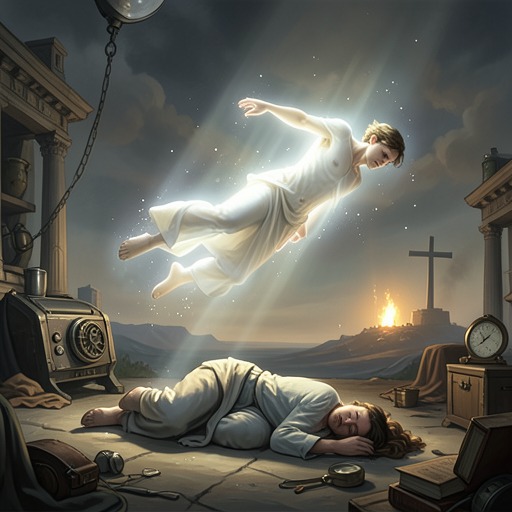
The Son then volunteers himself. He offers life for life, asks that divine anger fall upon him, and agrees to leave the Father’s bosom and glory, assume human nature, and die for mankind. His offer is not compelled by external necessity or forced upon him by the Father. It is a deliberate act of love that renews an earlier divine purpose: humanity will not be wholly lost, but will be saved insofar as grace is freely bestowed and received. The Son’s willingness makes mercy compatible with justice because he does not simply cancel the penalty; he bears it.
God accepts the Son’s proposal and gives the redemptive plan its full form. The Son is to join human nature to his divine nature, become Man among men through the wondrous birth from Virgin seed, and stand in Adam’s place as the new Head of mankind. As guilt spreads from Adam to his descendants, the Son’s merit will be imputed to those who renounce their own claims and live through him. Humanity will therefore satisfy for humanity: the Son will be judged and die, then rise and raise those ransomed by his life.
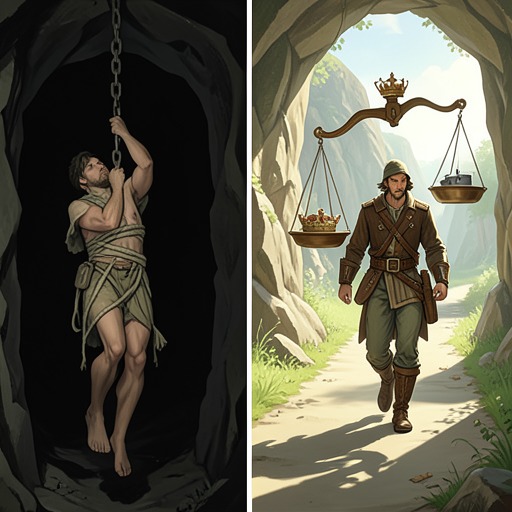
The Father presents this humiliation as the supreme revelation of the Son’s worth. Although the Son already shares the highest bliss and Godlike enjoyment, he willingly leaves it to save a world from utter loss. His elevation does not rest on birthright or rank alone, but on goodness and overflowing love. Because the Son is willing to become low for the sake of mankind, God promises that his Manhood will be exalted with him. He will reign as both God and Man, universal King, while the act of self-emptying becomes the ground of a greater kingship.
Judgment, Resurrection, and Universal Rule
The Son’s redemptive mission includes not only death but victory over death. He foresees that he will rise from the grave, defeat the power that appears to vanquish him, disarm Death, lead the powers of darkness captive, and return to Heaven in triumph. The Father confirms that the Son’s incarnation will culminate in universal authority: all knees in Heaven, on Earth, and under the Earth will bow before him.
The Son is appointed judge of the final assembly, when the living and the dead of all ages are summoned. He will judge both wicked humanity and the rebellious Angels, while Hell is filled and shut forever. The World will then burn, and from its ashes will arise a new Heaven and Earth in which the just dwell through golden days, fruitful deeds, joy, love, and truth. At the end of this process, the Son lays aside the regal scepter because a separate instrument of rule is no longer necessary. The movement from the Father’s decree to the Son’s reign and finally to the Father’s being “All in All” gives the relation a circular completion: authority proceeds from God, is embodied and exercised by the Son, and returns to the Father in perfected unity.
The same pattern governs the later history revealed to Adam. The Son will fulfill the Law through obedience and love, endure a reproachful life and cursed death, and be nailed to the Cross by his own Nation. Yet his death will also nail the law against humanity and the sins of mankind to the Cross, preventing them from harming those who trust in his satisfaction. His resurrection on the third day will announce that Death cannot retain him, while his ascension will place him again at God’s right hand, above every name in Heaven.
Mediation and the Extension of Divine Life
The Son’s relation to God is also the basis of mediation between God and humanity. After ascending, he sends the promised Comforter from Heaven to dwell within his followers. The Law of Faith, working through love, is written upon their hearts; spiritual armor enables them to resist Satan’s assaults, and the Spirit grants gifts such as tongues and miracles. The Son’s work therefore does not end with his departure from Earth. His relation to the Father becomes a channel through which divine guidance, consolation, and power reach the human community.
This mediating structure is foreshadowed in the history of Israel. Moses receives and reports the divine will because direct access to God is too terrible for mortal hearers, and his office appears as a figure of the greater Mediator. The Tabernacle, the Ark of the Covenant, the Mercy-seat, and the sacred lamps establish a provisional form of divine dwelling among humanity, while the Law exposes sin without finally removing it. These rites point toward the Son, whose obedience, suffering, and self-offering accomplish what animal sacrifices cannot: justification and peace of conscience through faith in his imputed merit.
The relation thus binds creation to restoration. God creates the World through the Son, forms Man in the divine image, and gives humanity dominion over the creatures. After human disobedience, the Son becomes the means by which the damaged image is renewed. The Son’s role is not a late repair detached from creation but the completion of the Father’s original purpose: the one through whom the World was made becomes the one through whom the fallen World is redeemed and finally transformed into a happier Paradise.
Narrative and Thematic Significance
God and the Son give the poem’s vast chronology its single governing pattern. In Heaven, their relation opposes Satan’s claim that freedom requires independence from all superior authority. In creation, it establishes the order through which life is made. In the Fall, it transforms an apparently irreversible sentence into a covenant of grace. In the future history of mankind, it connects law, sacrifice, incarnation, crucifixion, resurrection, ascension, judgment, and renewal.
The relation also mediates the poem’s fundamental contrasts: decree and freedom, justice and mercy, sovereignty and service, divine glory and voluntary humiliation, death and immortal life. God’s authority is never separated from purpose, and the Son’s obedience is never reduced to passive submission. The Father commands because he seeks the good of creation; the Son obeys because love makes the Father’s will his own delight. Their unity therefore supplies the poem’s answer to rebellion: true liberty is not the refusal of all rule, but willing participation in a righteous order whose highest expression is self-giving love.
In this relation, political and theological authority are inseparable. Satan imagines monarchy as a yoke imposed on equals and seeks a throne through accusation, manipulation, and force. God’s sovereignty, by contrast, is expressed through the Son, whose right to rule is confirmed by creation, freely accepted obedience, victorious action, sacrificial suffering, and restorative judgment. The Son is most fully revealed as King precisely when he offers himself for those who cannot redeem themselves. The Father–Son relationship therefore stands as the poem’s decisive structure of legitimate power: authority becomes most glorious when it serves the rescue and renewal of the world.